Does Weather Influence mountain Bike Demand?
There is a persistent claim in the bike industry: bike sales are not impacted by weather. To me, this feels like a lacking statement. Using common sense, one can conclude that a prospective buyer will be more keen to test ride a bike in sunny weather over rainy weather— comfortable temperatures over extreme temperatures. Instead of debating the claim with no proof, I wanted to test a simple version of it:
Is there any measurable relationship between weather conditions and interest in mountain biking?
The short answer is yes— weather impacts interest in bike. The long answer is: I don’t have access to real bike sales data (yet) to know for sure. The goal of this mini research project is to serve as a proof of concept and is a first pass at identifying whether a signal exists at all.
Framing the Problem
Direct bike sales data is hard to access at a granular level. Instead, I used Google Trends search interest for “mountain bike” in the Philadelphia area as a proxy for demand. It’s not perfect, but it captures something meaningful: intent. The idea is simple: people who are searching for mountain bikes are likely trying to buy a mountain bike. I stuck to mountain bikes for two reasons (1) I am a mountain biker, so I am biased and (2) while looking at search trends for road bikes, I noticed two peaks— one occurring around the start of summer and a second occurring around the Tour De France.
For the weather component, I chose daily weather observations from Philadelphia International Airport for this case study. The idea is that Philadelphia is susceptible to seasonality and variable weather. For this analysis I included:
Average temperature
Wind speed
Precipitation (converted to rain/no rain)
Day of week (weekday vs weekend)
The dataset is small—22 days of usable observations—so this is not about building a production-ready model. I ran a simple linear regression to estimate how each weather factor relates to daily search interest. I also included a lagged temperature variable (yesterday’s temperature) to capture the idea that people may respond to recent weather patterns, not just the current day.
Results
At a high level, the model explains about 48% of the variation in search interest (R² = 0.476). For a small, noisy dataset, the results are at least meaningful and suggest that there is a measurable signal between weather and search interest.
Weekends Matter—A Lot
The strongest and most reliable result are weekends. An unexpected result but it makes a lot of sense. Weekends saw a +22 point increase in search interest and the model results were statistically significant. Weather matters, but only within the constraints of people’s schedules.
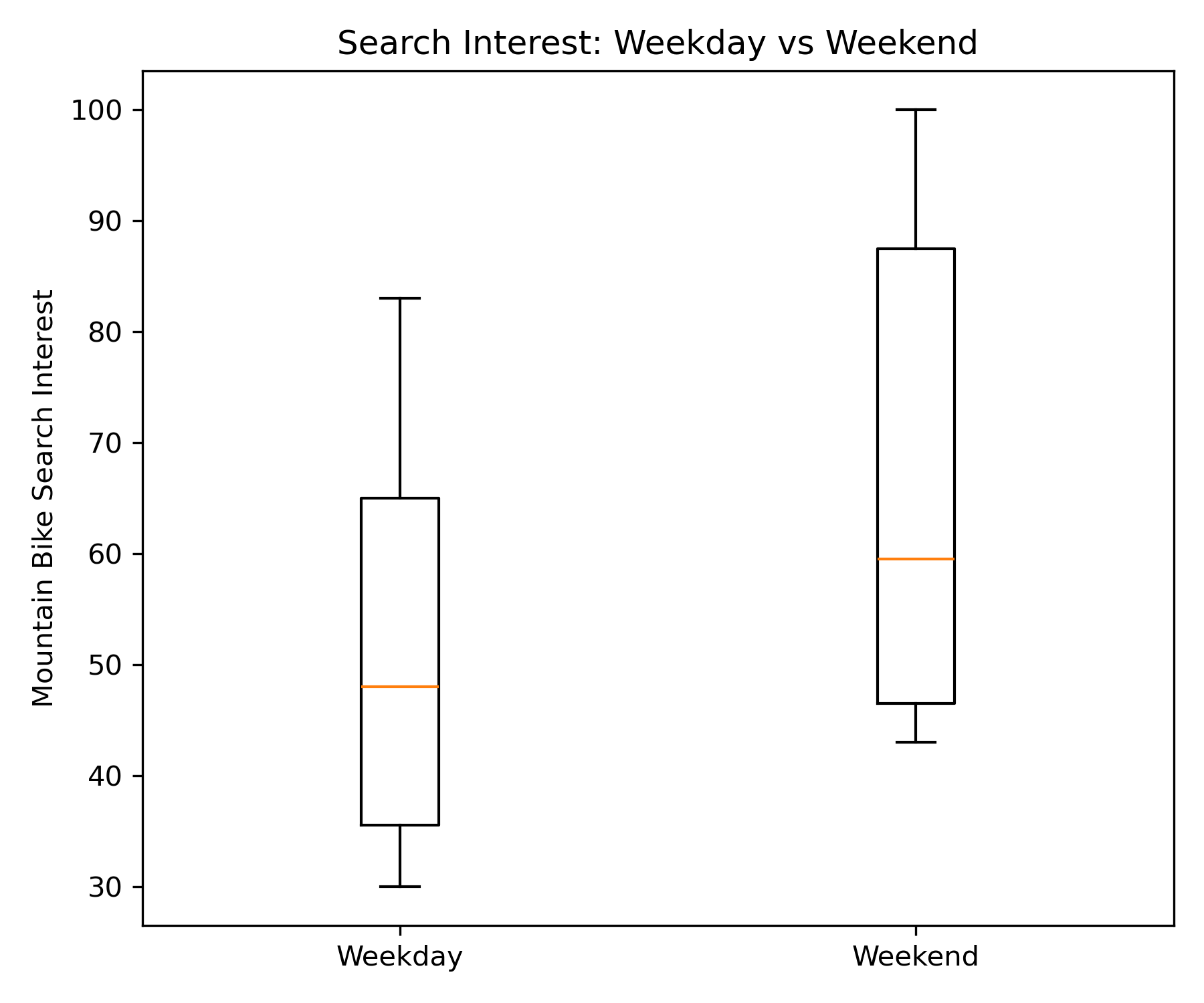
Box plot comparing mountain bike searches on weekdays versus weekends.
Rain Suppresses Interest
Rain is shown to have a strong negative effect of search interest with a ~16 point drop on rainy days. While only marginally significant in this small sample, the magnitude is large and directionally consistent with expectations. Rain impacting interest in outdoor activities aligns well with real-world behavior.
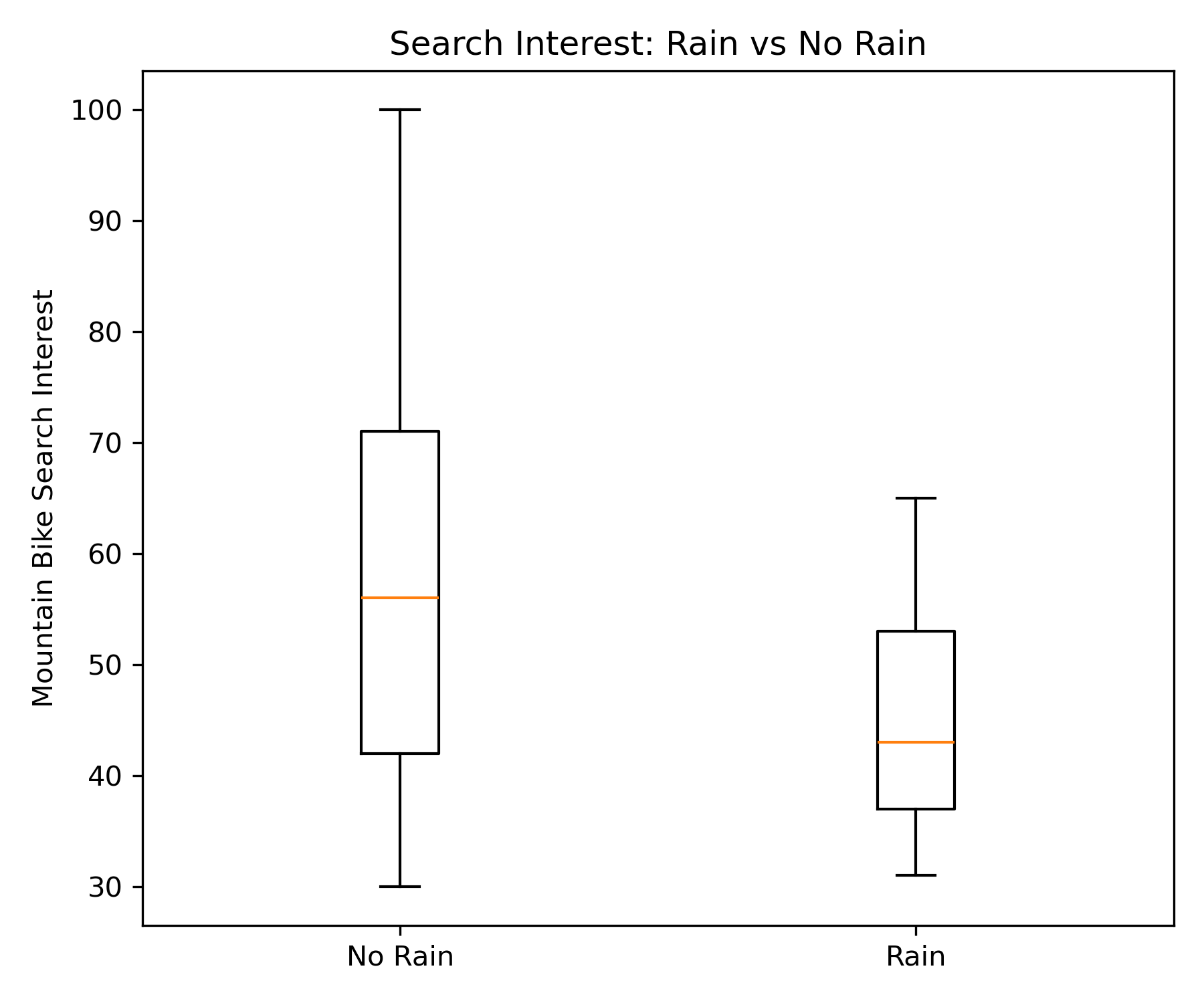
Box plot comparing mountain bike interest on rainy versus non-rainy days.
Temperature Is Surprisingly Weak (Here)
Temperature has a positive relationship with search interest, but surprisingly it is not statistically significant in this model. In theory, I expect interest to be higher is warmer weather and lower in cooler weather. The results of this model do not necessarily mean temperature doesn’t matter; more likely the sample size is too small to really understand temperatures impact on mountain bike interest. The takeaway is that it will be worth my time to download more data.
Wind Appears Positive (But Probably Isn’t)
Wind shows a statistically significant positive relationship with search interest. Higher wind speeds = higher searches. Wind is created by difference in pressure between a high and low pressure systems, where low pressure systems are typically associated with cruddy weather and high pressures are associated with brisk, beautiful weather. I’m not too sure what to make of these results for wind from this model. Adding pressure as a variable may help us to understand the type of weather that created the wind. Since it can be windy on a beautiful, sunny day or during a fierce thunderstorm, it’s tough to even hypothesize how wind would impact consumers interest in mountain biking. On one side, windy days might keep people inside, thereby boosting searches. On the other side, wind and rain might dampen search interest.
Lagged Temperature Component Is Unstable
The previous day’s temperature shows a negative relationship, but it’s weak, and might not be an interesting story to tell anyway. Given the weak signal from temperature in general, I wouldn’t expect temperature lag to have much influence. A larger dataset with more temperature variability will provide better insights.
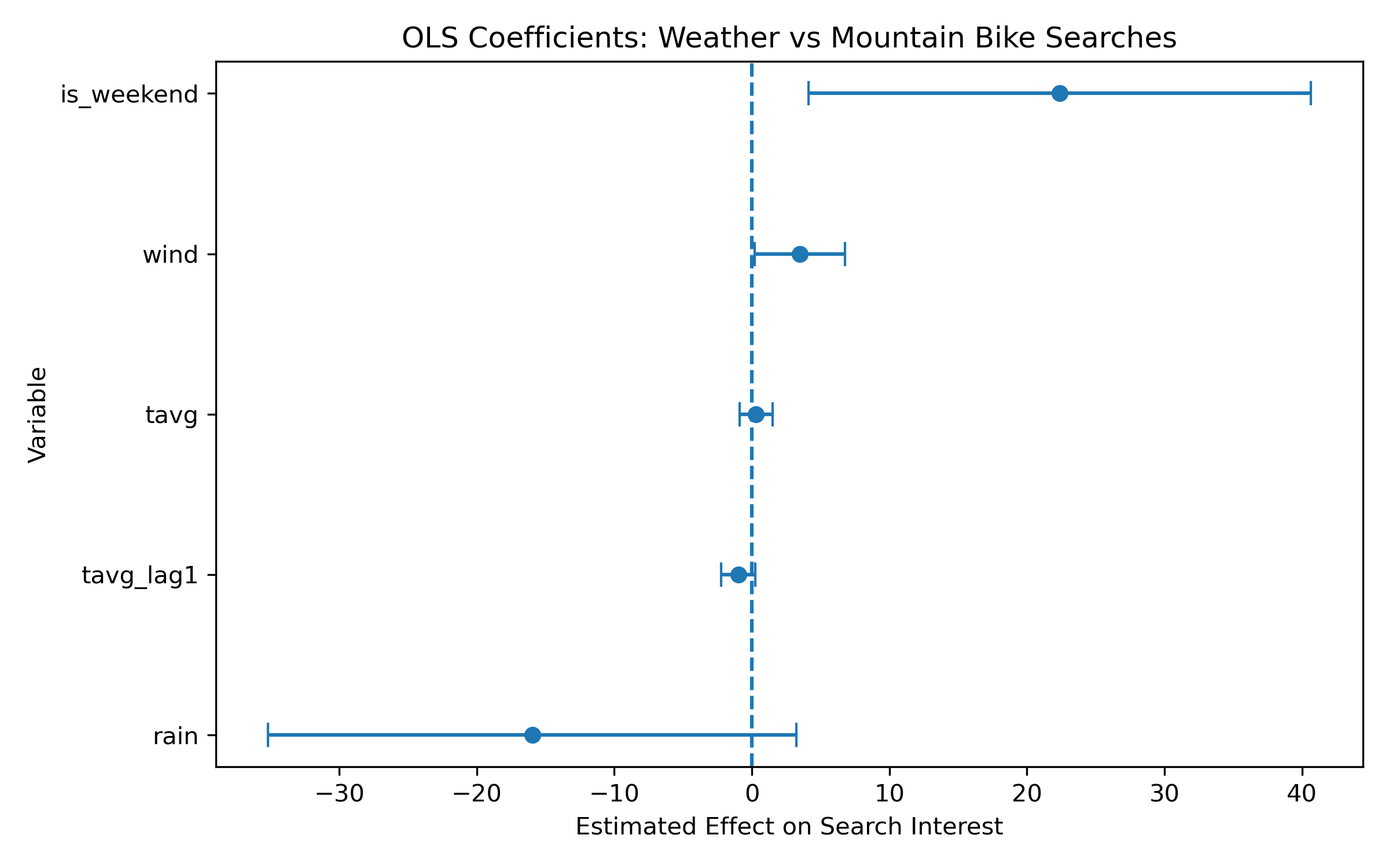
Model variables and how that influence mountain bike interest. Negative (positive) values correlate to decreased (increased) interest.
Summary
Taken together, the results suggest something important: Weather does influence biking interest—but not in a simple way. Contrary to what I originally though, the strongest signals are not changes in temperature. We found that people respond strongly to bad conditions (rain) and they act when they have time (strong weekend signal).
Everything else is secondary—or harder to detect with limited data.
Limitations and what’s next
This is a proof of concept, and it has real limitations:
Small sample size (~22 days)
Single location (Philadelphia)
Short time window (no seasonality)
Google Trends reflects relative interest, not actual sales
Linear model may miss nonlinear or threshold effects
This is the first step in a broader exploration. Next, I will expand the dataset to capture seasonal effects by gathering multiple months worth of weather and search data. I am also considering different temperature variables like rolling averages or daily max/min. I will continue to refine the model by removing unstable variables and test alternative structures. The goal isn’t just to improve accuracy—it’s to better understand how weather influences behavior.
Final Thoughts
Even with limitations, the key takeaway is clear: there is measurable signal between weather and biking interest. That alone challenges the blanket statement that “bike sales are not affected by weather.” It also proves that it is worth my time to download more data and to take a deeper look.
This analysis doesn’t prove a direct causal link to sales—but it shows that consumer interest moves with weather conditions, particularly when conditions are extreme in either direction. In the future, I hope to build a model that helps bike companies forecast upcoming weather patterns to improve logistics and inventory planning. For now, we’ll focus on identifying which weather patterns influence bike interest most.
This is just a starting point, but it’s enough to say that the relationship is real. Now it’s worth understanding properly.
